Playbook
Growth through AI: The Executive Playbook
Our playbook: how to take AI from experiment to measurable growth, with decision gates, governance and templates.
41 pages · EnglishSummary98% of companies are at least experimenting with AI. Only 4% generate substantial value from it, and 74% have yet to see tangible value (BCG, 2024). The difference rarely lies in the technology, but in the decisions executive teams take, and in their order. This path shows which decisions these are, who takes them and what helps.
Choose your industry: the recommendations and use cases along the path and the library adapt.
 Our playbook · 41 pagesGrowth through AIThe path follows this playbook: from the first assessment to the Quarterly Growth Review.Read the key points →
98% of companies are at least experimenting with AI. But only about a quarter have developed an AI strategy and built the capabilities to implement it. What matters is not whether, but what for.
To step 0 ↓Only 4% generate substantial value from AI, a further 22% see first impact, 74% none that is tangible. Invest where the benefit shows in business figures. An initiative just for learning often creates more risk and resistance than benefit.
To step 2 ↓Successful companies put 10% of their resources into algorithms, 20% into technology and data, and 70% into people and processes. So we do not start with technology, but with your strengths and weaknesses, your goals and where you see your company in three to five years.
To step 1 ↓No form, no score, nothing is stored. Answer the questions for yourself.
Where an answer does not come straight away, that is your starting point. In our conversations, many executive teams find this for at least two of the questions.
The path follows our playbook "Growth through AI". At every step a free route remains open. Our services start where a team needs to agree and decide. The report to the board in step 4 opens the next round.
Where do we really stand?
Why now: An honest assessment takes a quarter of an hour and keeps you from starting in the wrong place.
Why AI, and what role does it play for us?
 GuideAI Guide for Leaders0Article · 3 minAI governance for boards: what Swiss data protection, FINMA and the EU AI Act require today
 GuideAI Guide for Industrial Production
Why now: The board’s responsibility applies today, even without an AI law.
What exactly should AI improve?
 GuideAI Guide for Financial, Tax and Legal Advisors
 PlaybookGrowth through AI
Typical use case: Client reporting with AI-supported commentary
GuideAI Guide for Industrial ProductionPlaybookGrowth through AITypical use case: Quote support in sales
 GuideAI Guide for FiduciariesGuideAI Guide for Financial, Tax and Legal Advisors
Typical use case: Correspondence in the firm’s own style
Why now: If you do not define success beforehand, you cannot prove it afterwards.
How do we get from pilot to impact?
Typical use case: KYC and onboarding
Typical use case: Knowledge assistant in maintenance
Typical use case: Matching email and tasks to the right matter
Why now: Most pilots do not fail because of technology, but because of adoption.
Has it paid off, and what comes next?
Why now: Without a fixed rhythm, every AI initiative loses momentum after the first success.
↺ The report to the board opens the next round at step 1.
Our playbook: how to take AI from experiment to measurable growth, with decision gates, governance and templates.
41 pages · EnglishSummaryWhere AI really creates value, where to start, and which structures to build from the outset.
12 pages · English, GermanSummaryUp to 40 % productivity potential, and why the biggest lever today lies in your existing production data.
20 pages · English, GermanSummaryOnly one in three fiduciary firms invests in digitalisation, nine in ten expect it. Three proven ways to start.
12 pages · GermanSummaryUp to 44 % of legal tasks are considered automatable. Where advisory firms win, and how to start safely.
12 pages · GermanSummaryDispatching, pricing, maintenance and service: where AI creates measurable value across mobility services.
14 pages · GermanSummaryHow executives use AI chatbots as assistants and sparring partners: five building blocks of a good prompt, ten tips and examples.
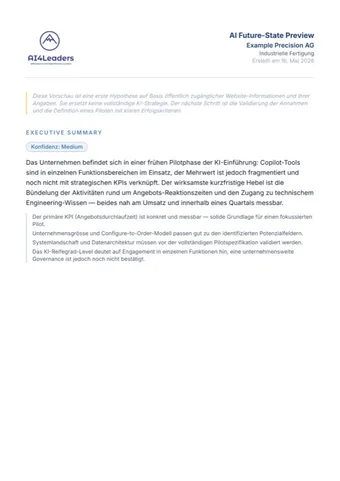
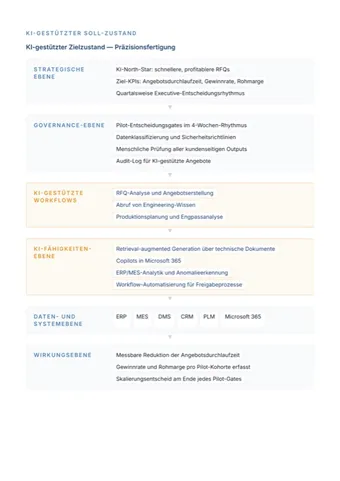
14 pages · GermanSummaryThe AI Future-State Simulator uses your website, goals and systems for a first assessment: opportunity areas, pilot direction and adoption path.
No items for this selection yet. Show all
Guides show patterns. What matters for your company is clarified fastest in a conversation, or you can start with a first assessment.