AI Guide for Financial, Tax and Legal Advisors
In legal, tax and financial advice, AI can take over a large share of routine work, from document analysis to client communication. The winners will be the firms that use AI deliberately and securely, and invest the time gained in more demanding, more personal advice.
This guide is available in German. This page summarises its key points in English.
 Adam D. Wisniewski
Managing Partner, AI4Leaders

Five insights from the guide
- 1
A large share of the work can be automated
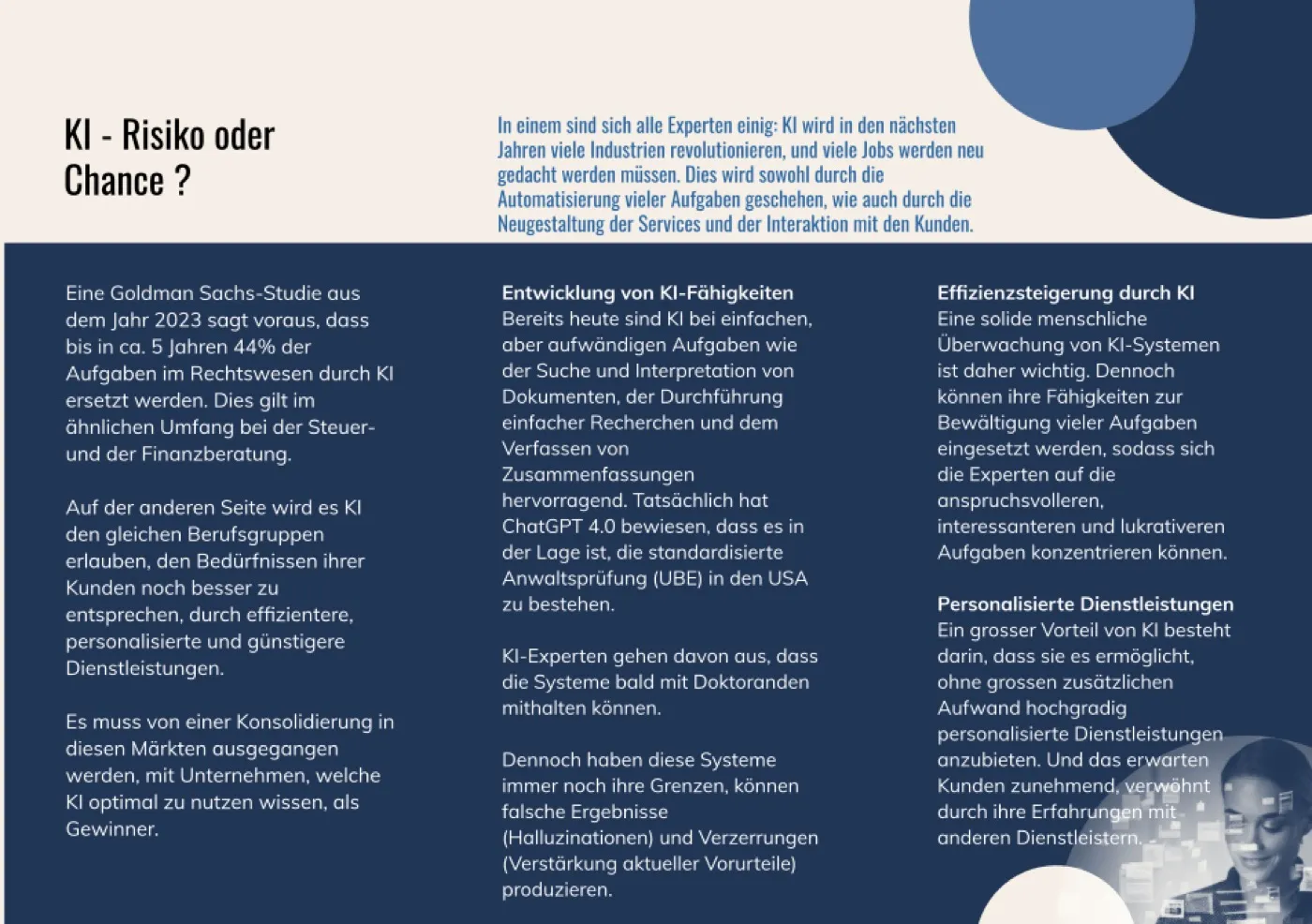
A Goldman Sachs study estimates that around 44 % of legal tasks can be taken over by AI, with similar shares in tax and financial advice. The market is likely to consolidate, with the best AI users as winners.
Source: Goldman Sachs, The Potentially Large Effects of AI on Economic Growth, March 2023
- 2
Where effort drops the most
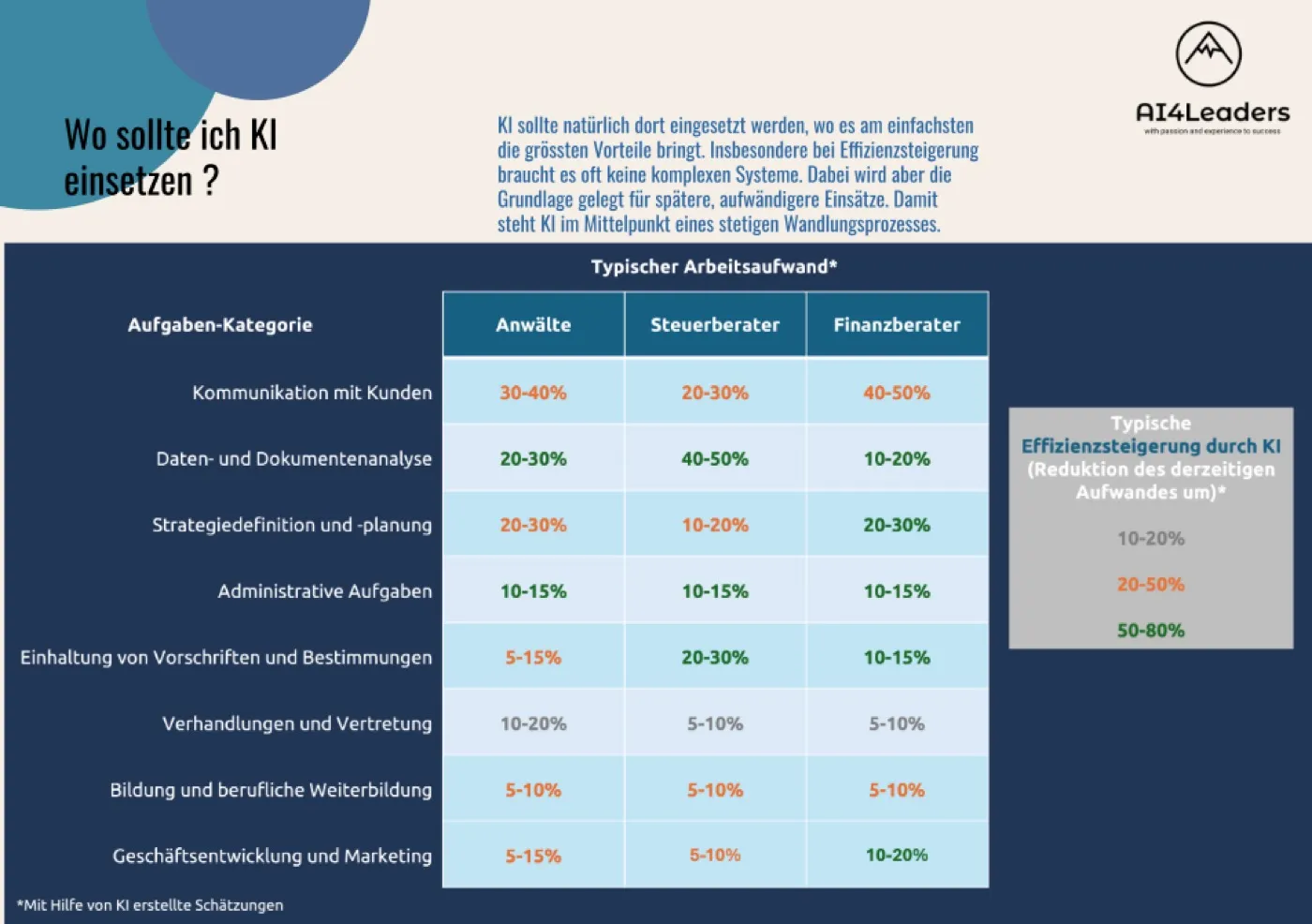
The potential is particularly large in client communication, data and document analysis and administrative tasks. The guide shows estimated efficiency gains by task category for lawyers, tax and financial advisors.
- 3
More personal advice without extra effort
AI enables highly personalised services without much additional effort. That is exactly what clients increasingly expect, shaped by their experience with other providers.
- 4
Three proven ways to start
An internal AI assistant for document search, analysis and answer suggestions; AI-supported lead qualification that identifies clients with the greatest need; and personalised reporting.
- 5
Human oversight remains essential
AI can hallucinate and reinforce bias. Confidential data stays within the company, access is limited to authorised staff, and professional responsibility always lies with the advisors.
- Owners and partners of law firms, tax and financial advisory firms
- Executive teams of advisory firms with confidential mandates
- Those responsible for digitalisation, compliance and data protection
- AI: why now?
- AI: risk or opportunity?
- Prerequisites for using AI
- Using AI securely
- Where should I use AI? (efficiency potential by task)
- Proven use cases
- Implementing an AI solution
- Specifics of AI initiatives
Two pages from the guide
The full guide is available free of charge as a PDF.
Frequently asked questions
Which advisory tasks are best suited to AI?
Client communication, data and document analysis and administrative tasks. Effort is high there and the work is easy to structure.
Is AI compatible with professional secrecy?
Yes, if confidential data stays within the company or is processed in suitable, contractually secured environments, access is limited and results are reviewed professionally.
Will AI replace advisors?
No. It takes over routine and preparatory work. Advisors gain time for more demanding, more personal and more lucrative tasks.
This guide belongs to Step 2: Goals, planning, funding. What exactly should AI improve?
See the whole path →Next step: Implementation, testing, scaling →

AI Guide for Fiduciaries
Only one in three fiduciary firms invests in digitalisation, nine in ten expect it. Three proven ways to start.

AI Guide for Industrial Production
Up to 40 % productivity potential, and why the biggest lever today lies in your existing production data.