AI for industrial SMEs: where workflows meet KPIs
Industrial companies hold rich operational, product and customer data. Much of it is locked in systems, documents, spreadsheets and the heads of experienced people. We make that value usable.
- Operational realityERP, MES, PLM, QMS
- Anchored in KPIsmargin, OEE, MTBF, lead time
- Expert knowledgecaptured and scaled
- Fast startno IT setup needed
Workflow KPIs, not generic AI inspiration
We focus on quote lead time, margin, OEE, MTBF, scrap, rework, downtime, inventory and service response time.
We start from your workflows, your system landscape and the KPIs that show whether an AI initiative paid off.
Manufacturing AI works when it improves measurable workflows
Six areas where AI makes the difference
Each opportunity is paired with the KPIs that show whether the AI work actually paid off.
| Area | AI opportunity | Value metric |
|---|---|---|
| Sales and RFQ | Quote support, CPQ assistance, technical sales copilot, margin risk flags | Quote lead time, win rate, margin |
| Engineering | Document search, change impact analysis, CAD and PLM knowledge assistant | Engineering effort, change lead time, reuse rate |
| Production planning | Planning support, bottleneck visibility, scenario planning | Lead time, OEE, on-time delivery, WIP |
| Quality | Anomaly detection, root cause support, defect patterns, QMS evidence | Scrap, rework, first pass yield, complaints |
| Maintenance | Predictive maintenance, service intelligence, maintenance knowledge assistant | Downtime, MTBF, maintenance cost, response time |
| Supply chain and service | Forecasting, supplier risk, inventory optimisation, ticket summaries | Stock-outs, inventory turns, first-time fix rate |
Proven in practice: the know-how of the best technicians for 30,000 colleagues
A leading machine manufacturer wanted to empower its technicians, not replace them. AI learns from the best experts and supports everyone in tool selection. Technicians save 4 minutes per process, and the know-how became a new revenue stream.
- 700,000 hsaved per year
- CHF 4.2mcost savings per year
- +20%productivity in CAM programming
In an SME, the same pattern works on a smaller scale: start where the know-how of a few experienced people becomes the bottleneck, for example in work preparation, quoting or troubleshooting.
Three common pitfalls
Boardroom analytics, no shop floor adoption
Dashboards reach the leadership review, nothing changes in production. Without planners, operators and sales engineers using the output, there is no value.
Complex production AI before the reachable wins
RFQ support, engineering knowledge and reporting are often faster to deliver and measure than vision systems or predictive maintenance. Start where momentum builds.
Systems treated as separate worlds
Real decisions touch ERP, MES, PLM, QMS and expert knowledge at once. The value lies in connecting systems, documents and people.
AI should strengthen experienced people, not bypass them
Valuable knowledge sits with sales engineers, planners, quality and maintenance teams. We involve them from the start. Use cases are chosen on measurable value, data, system fit and acceptance.
Strategic clarity, not AI hype
Our Zurich approach is rooted in Swiss pragmatism: clear decision points, measurable KPI impact, awareness of data sovereignty and governance under FADP and GDPR from day one. We do not measure your readiness; we show which AI work is worth doing.
Start with an analysis for your operation
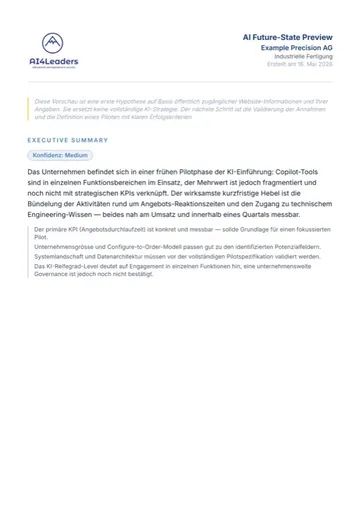
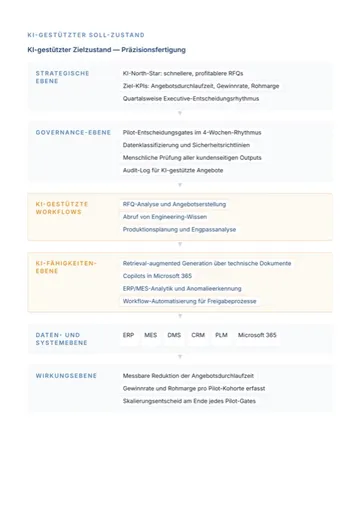
The simulator uses your website, manufacturing segment, goals, pain points, systems and target KPIs to produce a first future-state hypothesis: opportunity areas, pilot direction and adoption path. The overview is free; the full report of around 10 pages arrives by email.
From AI North Star to pilots and scale, at your pace
For industrial and manufacturing companies: from North Star through prioritised use cases in production, service and sales to pilots that hold up in operations.
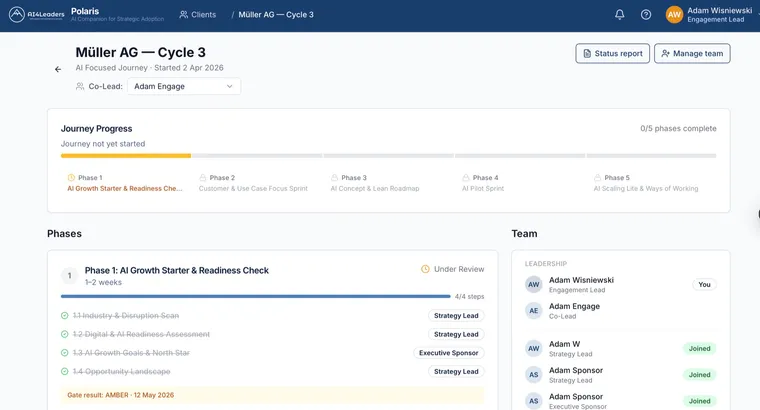
Polaris is our digital AI adoption companion for executive teams. AI prepares and reviews every task, your team decides, and our partners join where strategic clarity matters most.
- 1WhyStrategic orientation
- 2WhatAI potential and landscape
- 3DecidePrioritise use cases
- 4ActPilot preparation
- 5ScaleScaling and governance
- 5 to 8 weeksuntil North Star, opportunities and pilot candidates are set
- Partner momentssenior partners at the decisive points
- Start nowno IT set-up needed
 The methodology behind PolarisGrowth through AIRead the key points →
Our guide on the topic
The path for your industry
Five steps from where you stand to proven impact, with the guides, articles and use cases that fit your industry.
Related articles
- over 30,000more people a year reach retirement age from 2029 than young people enter the workforceIn practice · 4 minAI in manufacturing SMEs: securing your experienced people's know-how, with ERP and MES rather than against themThe skilled labour shortage eased in 2025, the wave of retirements did not. AI helps manufacturing SMEs most where know-how becomes scarce, and it builds on ERP and MES instead of replacing them.
- +20%more productivity: the best experts' knowledge for everyoneIn practice · 3 minThe know-how of the best, for everyone: AI in CAM programming at HexagonHow an AI copilot makes the experience of the best CAM programmers available to everyone, and what SMEs can learn from it.
Also relevant for executive teams
 AI Guide for LeadersRead the summary →
Frequently asked questions
Where does AI create the most value in manufacturing?
In RFQ and technical sales, engineering knowledge, ERP and PLM sync, planning, quality, maintenance, supply chain and service. The right starting point depends on your KPIs, systems and data availability.
Start on the shop floor or in office processes?
Where value is measurable and data is accessible. For many SMEs, RFQ, reporting or engineering knowledge make better first pilots than deep production integration.
How do you measure AI value in manufacturing?
With quote lead time, win rate, margin, OEE, lead time, scrap, rework, MTBF, downtime and inventory turns. Usage numbers alone are not enough.
How do you involve the experts?
Early, to understand constraints, exceptions, data quality and routines. Without their knowledge, even technically strong use cases fail to land in daily work.
Ready to explore your AI potential in manufacturing?
Whether you start with the simulator, a conversation or directly with Polaris, the first step is a conversation that takes your company, your controls and your people seriously.