The know-how of the best, for everyone: AI in CAM programming at Hexagon
 Adam D. Wisniewski, Managing Partner
17 October 2026
With an AI copilot and ProPlanAI, Hexagon made the know-how of experienced CAM programmers available to all users. Technicians save around 4 minutes per process, which adds up to around 700,000 hours and CHF 4.2m per year, and the knowledge became a new source of revenue. The pattern transfers to SMEs: start where scarce expert knowledge becomes the bottleneck.
The starting point
Hexagon is a global leader in measurement technology and manufacturing software, with around 25,000 employees at some 300 locations. Tens of thousands of users in manufacturing use Hexagon’s software to program machine tools.
CAM (computer-aided manufacturing) programming is complex. Which tools, toolpaths and parameters work best for a given part is known mainly by experienced CAM programmers. Exactly these specialists are scarce. Less experienced technicians lose time, search for solutions or wait for advice.
The bottleneck was not the machine, but access to the knowledge of the best.
The solution: a copilot that learns from the best
The Hexagon Copilot and ProPlanAI brought AI support directly into the CAM software:
- Expert knowledge on demand: users get expert-level advice and suggestions regardless of their own experience.
- Answers without waiting: the information is there when it is needed, without leaving the software.
- AI-driven process planning: programming is automated and adapted to the capabilities and preferences of each operation.
- Capturing knowledge: the solution learns from the programs of experienced specialists and keeps that knowledge available in the company.
- Continuous learning: it responds to changes in the process and keeps learning from historical and live data.
Hexagon presented ProPlanAI in November 2024 and cites a reduction of up to 75 percent in machine tool programming time. Technically, the solution builds on Hexagon’s Nexus platform and Microsoft Azure services.
The impact
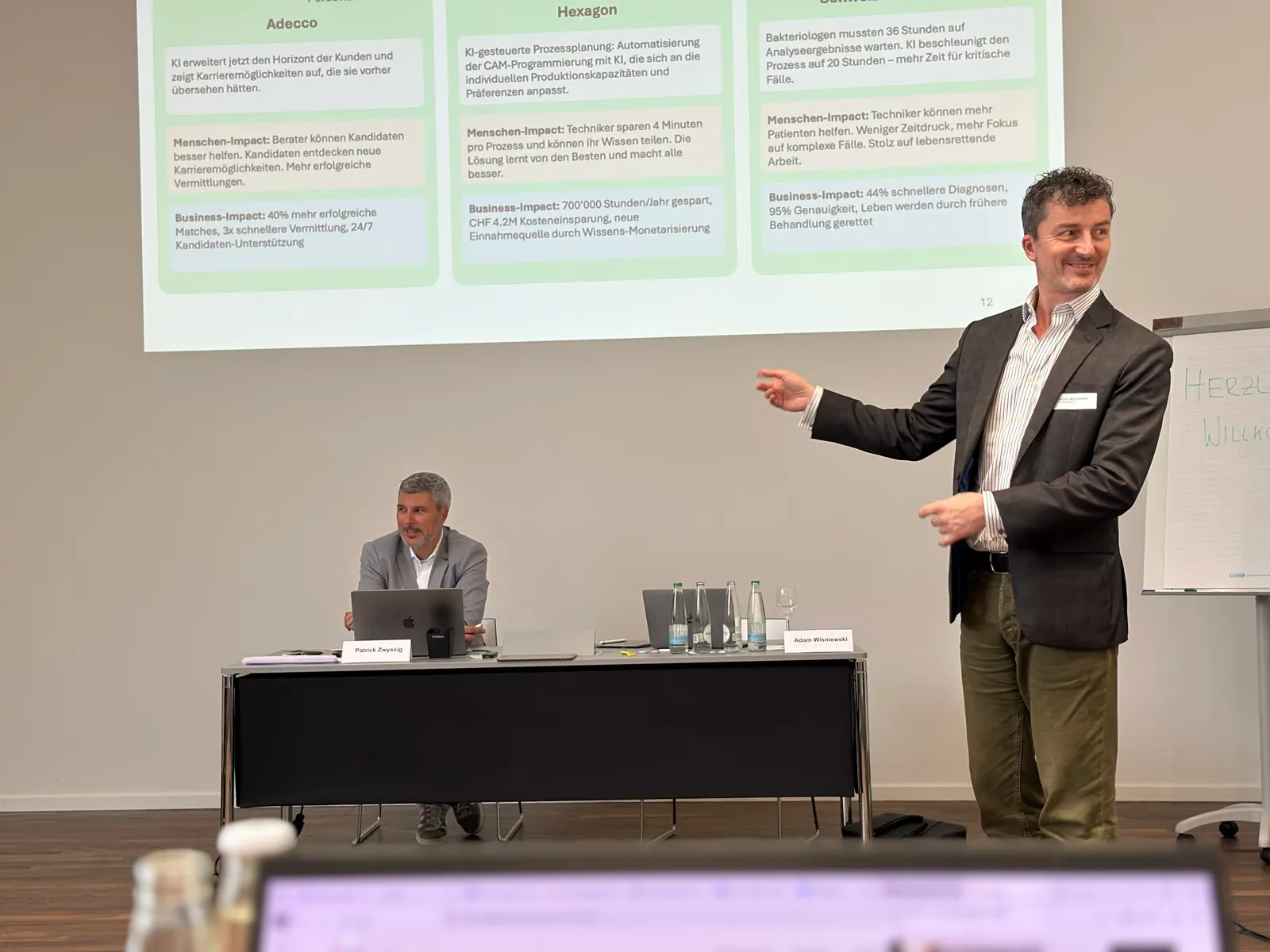
Our Managing Partner Adam D. Wisniewski contributed to this project. The impact shows on two levels:
| Level | Impact |
|---|---|
| For people | Technicians save around 4 minutes per process and can share their knowledge. Productivity rose by around 20 percent, and so did satisfaction. |
| For the business | Extrapolated, around 700,000 hours and CHF 4.2m in cost savings per year, plus a new revenue stream because the knowledge is sold as an add-on. |
The last point stands out: the captured experience is not only an efficiency gain; it has become a product of its own.
What SMEs can learn from it
Few SMEs build a platform for tens of thousands of users. The underlying pattern, however, transfers directly:
- Start at the bottleneck, not with the technology. Look for the point where scarce expert knowledge slows work down: quoting, setup, programming, troubleshooting, service.
- Involve the best. The solution is only as good as the knowledge it learns from. Experienced specialists must be co-designers, not bystanders.
- Help where the work happens. Support inside the familiar tool gets used. An extra program on the side often does not.
- Measure time per task. Four minutes per process sounds small. Multiplied by the number of tasks, it becomes a figure every executive team understands.
- Treat knowledge as value. What saves time internally can become an offering for customers or partners.
What this can look like in an SME
| Large enterprise | SME with 50 to 1,000 employees |
|---|---|
| Copilot inside its own CAM software for tens of thousands of users | Knowledge assistant built on your own programs, setup sheets and experience notes |
| Machine learning on large data volumes | Generative AI on a manageable, well-maintained knowledge base |
| New product for the market | Faster onboarding, less dependence on individual specialists, shorter quoting and setup times |
The first step is the same in both cases: find the point where the knowledge of your best people is becoming a bottleneck today, and measure what that bottleneck costs.
Sources
- Hexagon: Hexagon’s new AI-powered automation slashes machine tool programming time by 75%, November 2024
- AI4Leaders: project overview and AI Guide for Industrial Production, September 2025
Frequently asked questions
Can an SME run a project like this?
Yes, on a smaller scale. Instead of a platform for tens of thousands of users, a knowledge assistant built on your own setup sheets, programs and experience notes is often enough. The same principles apply: scarce expert knowledge, measurable time per task and close involvement of the specialists.
Does the AI replace the experienced programmers?
No. It learns from the best and makes that knowledge available to everyone. Experienced specialists are relieved, and less experienced staff become productive faster.
What data does it need?
Mainly the work results that exist anyway: existing programs, parameters, setup sheets and documentation. The bigger effort is usually making them accessible and cleanly usable.
Where is the expert knowledge in your operation that is becoming a bottleneck?
Our Industrial Manufacturing page shows the opportunity map with typical use cases and KPIs. For a first assessment of your operation, the simulator is enough.
AI in Industrial ManufacturingThis article belongs to Step 3: Implementation, testing, scaling. How do we get from pilot to impact?