AI Guide for Fiduciaries
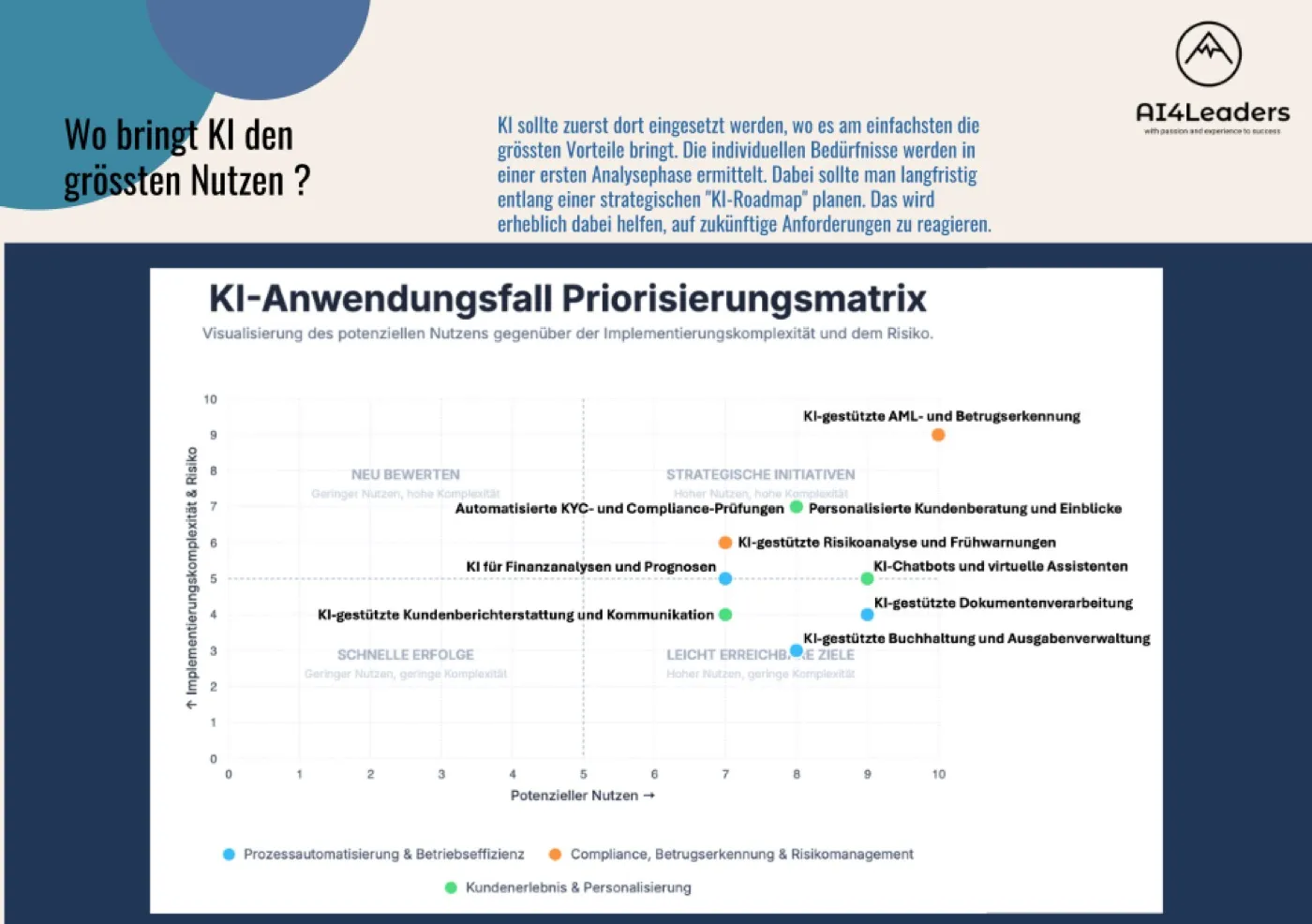
Fiduciary firms are caught between billing by the hour and rising client expectations. AI helps above all with process efficiency, compliance and client experience. The best entry points are applications with quickly measurable benefit, low risk and hardly any change to existing workflows.
This guide is available in German. This page summarises its key points in English.
 Adam D. Wisniewski
Managing Partner, AI4Leaders

Five insights from the guide
- 1
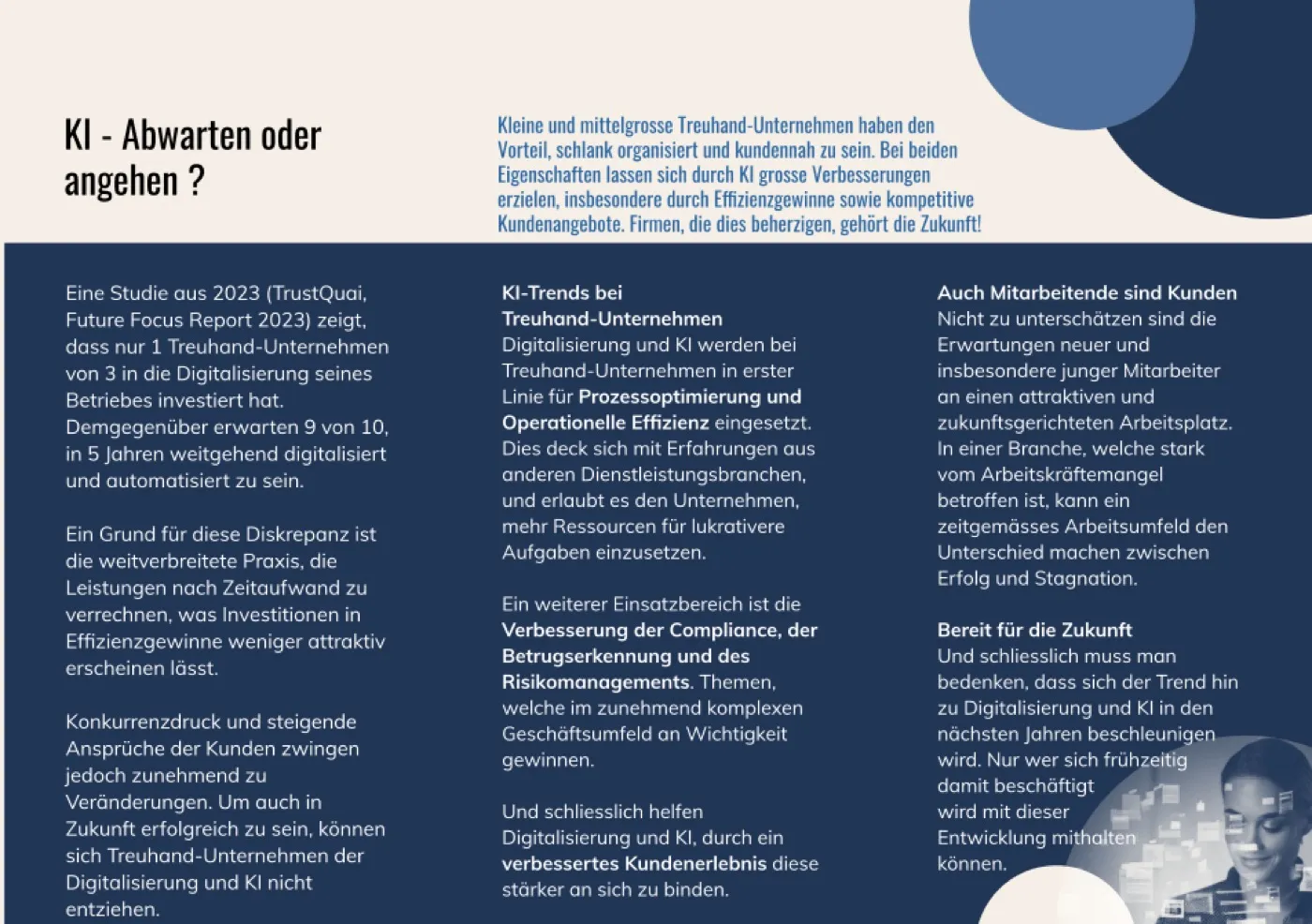
Investment lags behind expectations
Only one in three fiduciary firms has invested in digitalisation. At the same time, nine in ten expect to be largely digitalised and automated within five years.
Source: TrustQuai, Future Focus Report 2023
- 2
Hourly billing slows, the market drives
Those who bill by effort see little incentive in efficiency gains. Competitive pressure, client expectations and the skills shortage force change nonetheless.
- 3
Three proven ways to start
An internal AI assistant that finds and summarises documents and proposes answers; AI-supported document processing that also creates a data foundation; and personalised reporting for individual clients.
- 4
Confidentiality can be solved
Data can stay within the company, accessible only to authorised staff and encrypted. Today the FADP and GDPR apply; Switzerland does not yet have AI-specific regulation like the EU AI Act.
- 5
AI competence at every level
Board, management and employees each need their own understanding of AI. And because AI keeps changing, every solution needs continuous monitoring.
- Owners and executive teams of fiduciary firms
- Small and mid-sized firms with growth ambitions
- Those responsible for digitalisation and compliance
- AI: why now?
- Wait or act?
- Prerequisites for using AI
- Using AI securely
- Where AI brings the greatest benefit
- Proven use cases
- Implementing an AI solution
- Specifics of AI initiatives
Two pages from the guide
The full guide is available free of charge as a PDF.
Frequently asked questions
May fiduciaries use AI with client data?
Yes, if the data stays within the company or is processed in suitable environments, access is limited to authorised staff and the FADP or GDPR is respected. Clear internal rules and trained employees are part of it.
Which AI use case is best to start with?
An internal assistant for document search and summaries, AI-supported document processing or personalised reporting. All three bring quickly measurable benefit at low risk.
Is AI worthwhile with hourly billing?
Yes, in the medium term. Efficiency creates capacity for value-adding advice, strengthens client loyalty and makes the firm more attractive as an employer.
This guide belongs to Step 2: Goals, planning, funding. What exactly should AI improve?
See the whole path →Next step: Implementation, testing, scaling →

AI Guide for Financial, Tax and Legal Advisors
Up to 44 % of legal tasks are considered automatable. Where advisory firms win, and how to start safely.

AI Guide for Industrial Production
Up to 40 % productivity potential, and why the biggest lever today lies in your existing production data.