AI Guide for Mobility and Transport
It will be a while before autonomous vehicles shape our roads. Competition today is about efficiency, service quality and the right pricing strategy, and that is exactly where AI already brings advantages. A particularly large lever lies in the interplay of the many services around mobility and transport.
This guide is available in German. This page summarises its key points in English.
 Adam D. Wisniewski
Managing Partner, AI4Leaders
Five insights from the guide
- 1
Competition is decided by efficiency and service today
Autonomous driving is still held back by law, liability and technology. Efficiency, service quality and pricing strategy decide today, and that is where AI has an immediate effect.
- 2
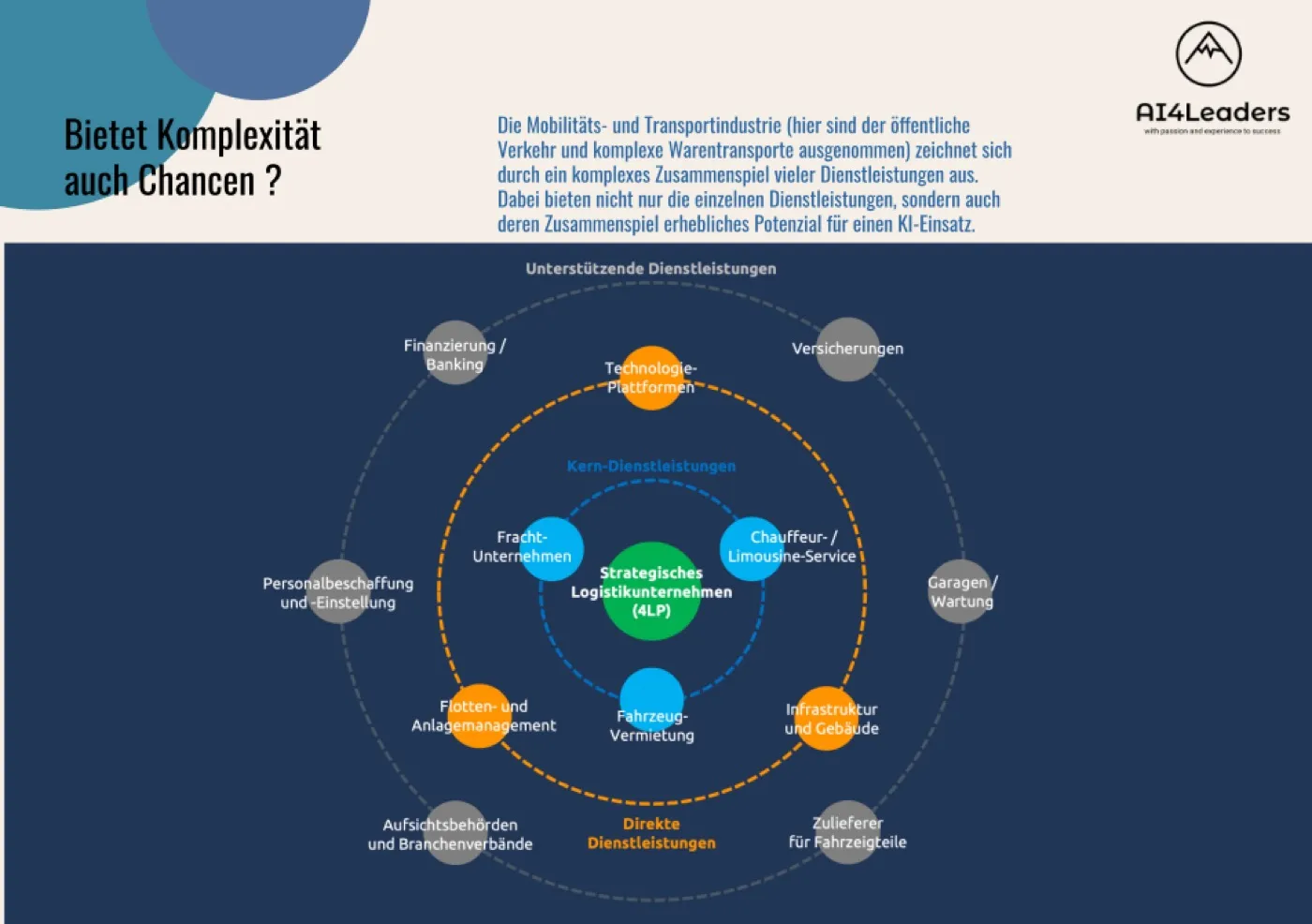
Complexity is an opportunity
Mobility is a network of core, direct and supporting services. Not only each service on its own, but above all their interplay and data exchange offer great potential.
- 3
Tactical first, then strategic
The first use case should solve an existing problem, have a measurable effect, carry little risk and be feasible with manageable effort. It is also the first step of an AI roadmap.
- 4
A typical first use case
AI-supported planning and assignment of vehicles and drivers is often possible with existing data and does not affect customers directly. The data collected enables further applications such as dynamic pricing.
- 5
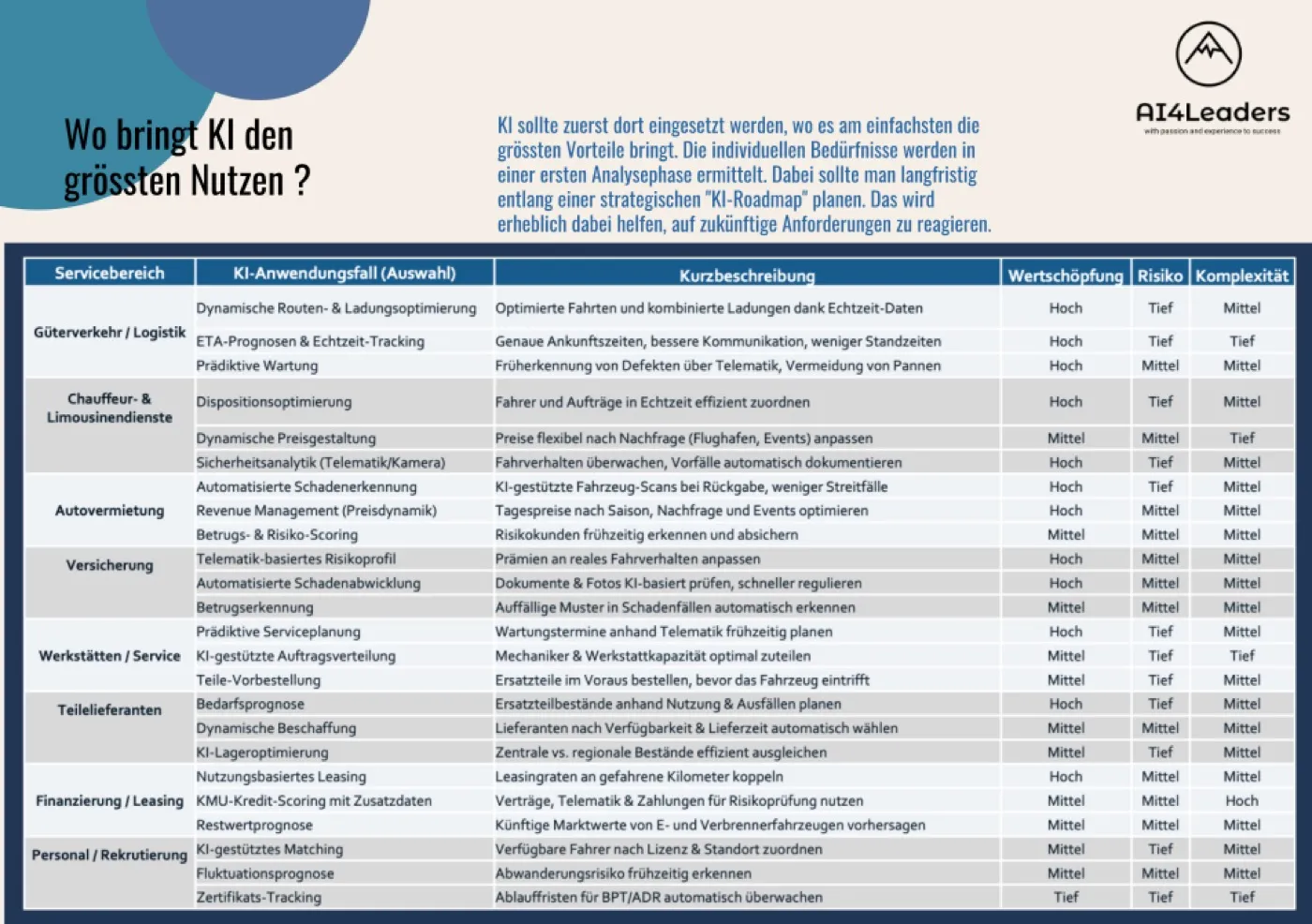
Over 30 use cases across services
From route and load optimisation through damage detection, predictive maintenance and spare parts forecasts to credit scoring in leasing: the guide rates them by value, risk and complexity.
- Executive teams of transport, logistics and mobility companies
- Providers of fleet, chauffeur, rental and workshop services
- Companies combining several mobility services
- AI: why now?
- Wait or act?
- Does complexity bring opportunities?
- AI use: tactical or strategic?
- Where AI brings the greatest benefit (use case overview)
- Proven use cases
- Prerequisites and security
- Implementation and specifics
Two pages from the guide
The full guide is available free of charge as a PDF.
Frequently asked questions
Where should mobility and transport companies start with AI?
With optimising existing processes and costs, for example AI-supported dispatching of vehicles and drivers. It uses existing data and does not affect customers directly.
Is AI worthwhile for smaller providers?
Yes. Many applications such as dispatching, damage detection or maintenance planning can be implemented with existing data and tools. Choosing the right first use case is what matters.
What does combining several services bring?
Providers of several services can exchange data and optimise the interplay, for example between fleet management, workshop and rental. That is often where the biggest lever lies.
Where do you stand? Our path shows in five steps which decisions are now on the table, who takes them and what helps.

AI Guide for Industrial Production
Up to 40 % productivity potential, and why the biggest lever today lies in your existing production data.

AI Guide for Fiduciaries
Only one in three fiduciary firms invests in digitalisation, nine in ten expect it. Three proven ways to start.