AI Prompting Guide for Executives
AI chatbots are a fast entry into AI for executives: as an assistant for analyses, reports and presentations and as a sparring partner for decisions. The quality of the results depends heavily on how the request is phrased. The more precise the role, context, task, format and constraints, the better the result.
This guide is available in German. This page summarises its key points in English.
 Adam D. Wisniewski
Managing Partner, AI4Leaders

Five insights from the guide
- 1
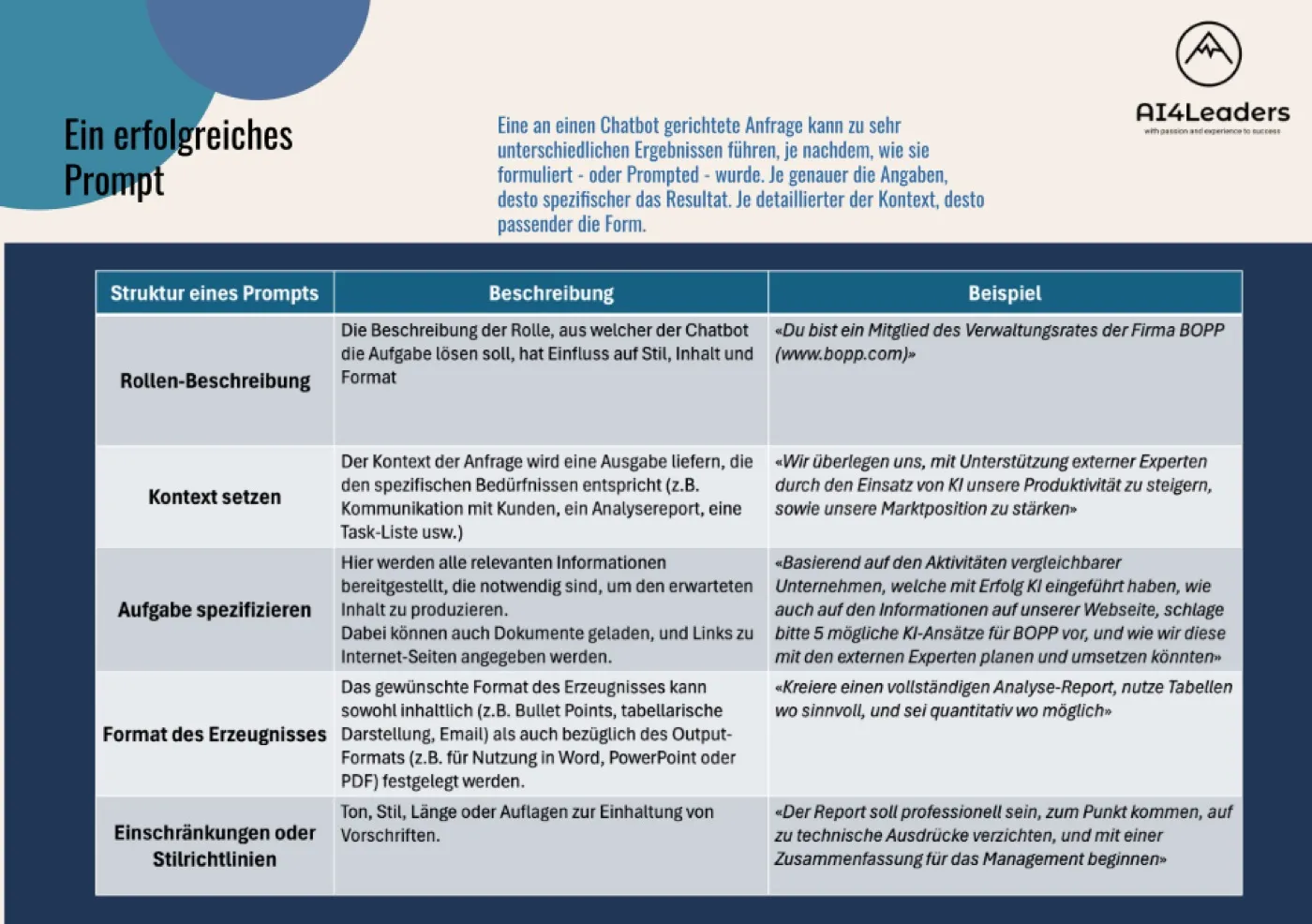
Five building blocks of a good prompt
Role, context, task, desired format, and constraints or style guidelines. Specifying these five points produces far more relevant results.
- 2
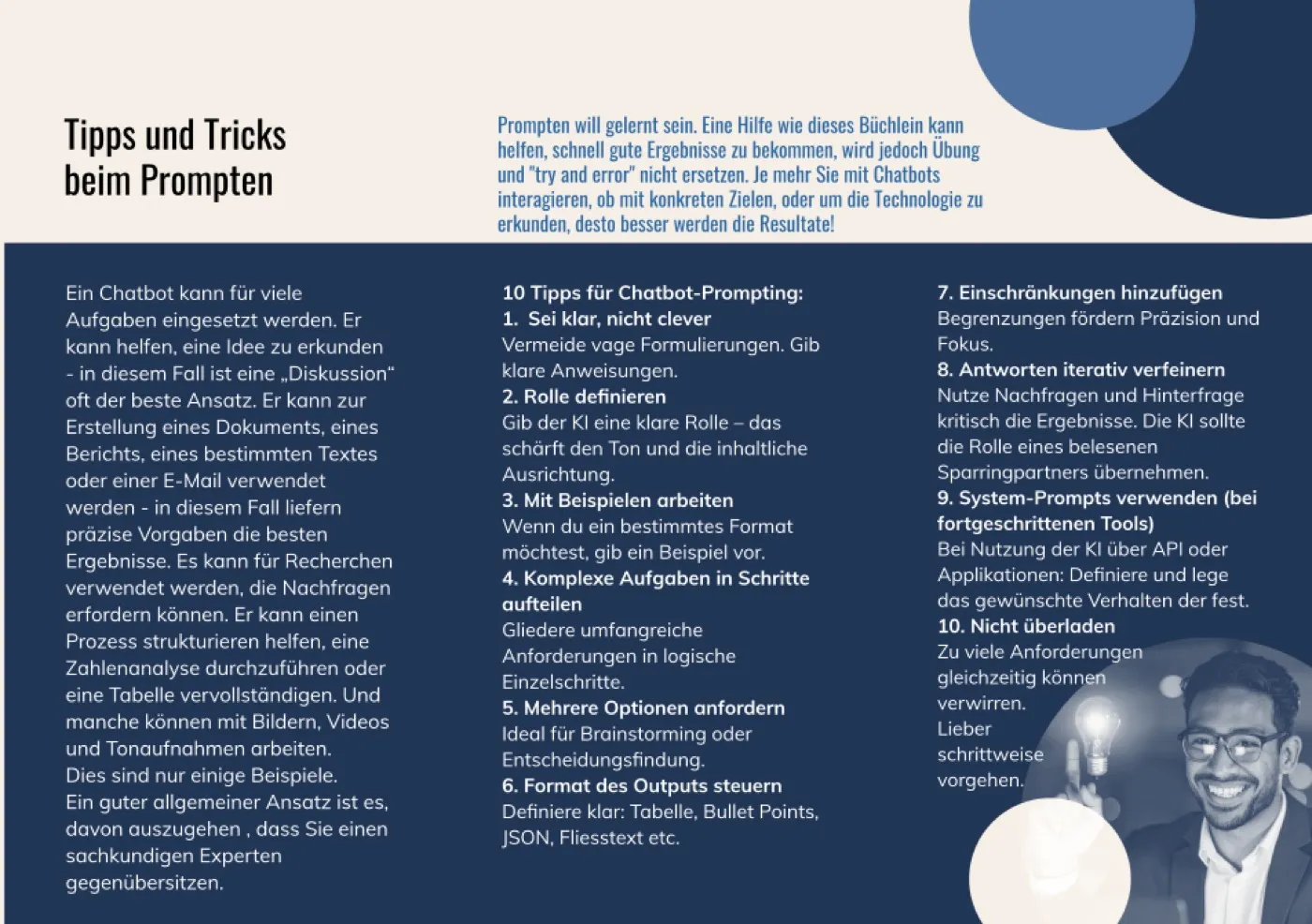
Like talking to a knowledgeable expert
The best approach: phrase requests as if sitting across from an expert. A dialogue works for ideas; precise instructions work for documents.
- 3
Ten tips from practice
Be clear, not clever; define a role; work with examples; split complex tasks; ask for several options; control the format; add constraints; refine iteratively; use system prompts; do not overload.
- 4
Care with data and results
Confidential data does not belong in public chatbots. Results can be wrong and must be checked. Intellectual property and possible bias also need attention.
- 5
Concrete examples for board and management
The guide contains complete prompts, for example for industry and competitive analyses, KPI systems for the board or integrated annual operating plans.
- Board members and executives who want to use AI themselves
- Leaders who want to get to robust analyses and drafts faster
- Anyone who wants to use AI chatbots safely and effectively every day
- An easy entry into AI
- How does generative AI work?
- Which AI chatbot to use?
- What to watch out for
- A successful prompt
- Prompting tips and tricks
- Use cases and prompt examples for the board
- Use cases and prompt examples for management
Two pages from the guide
The full guide is available free of charge as a PDF.
Frequently asked questions
Which chatbot should executives use?
It depends on task, cost and data protection. For company data only enterprise versions with clear contractual terms are suitable. For first experiments with public information, the common chatbots are enough.
How do I avoid wrong answers?
Give clear instructions, ask for sources, question critically and always check results. Chatbots can give convincing but wrong answers.
What does not belong in a chatbot?
Confidential information, personal data and trade secrets, unless the tool is explicitly approved for them.
Where do you stand? Our path shows in five steps which decisions are now on the table, who takes them and what helps.

AI Guide for Industrial Production
Up to 40 % productivity potential, and why the biggest lever today lies in your existing production data.

AI Guide for Fiduciaries
Only one in three fiduciary firms invests in digitalisation, nine in ten expect it. Three proven ways to start.